As eco-conscious consumer demand shifts from a niche trend to a standard baseline, swimwear brands are under increasing pressure to source sustainable performance textiles. Among recycled synthetics, ECONYL® regenerated nylon has emerged as a premium textile choice for high-end bikinis, competitive swimwear, and active performance lines.
For swimwear brand,switching to sustainable fabrics requires balancing environmental messaging with physical garment performance, supply chain traceability, and unit costs.
This guide details how ECONYL fabric is produced, its technical performance relative to virgin nylon, and key manufacturing considerations for your next swimwear collection.
What Is ECONYL Fabric?
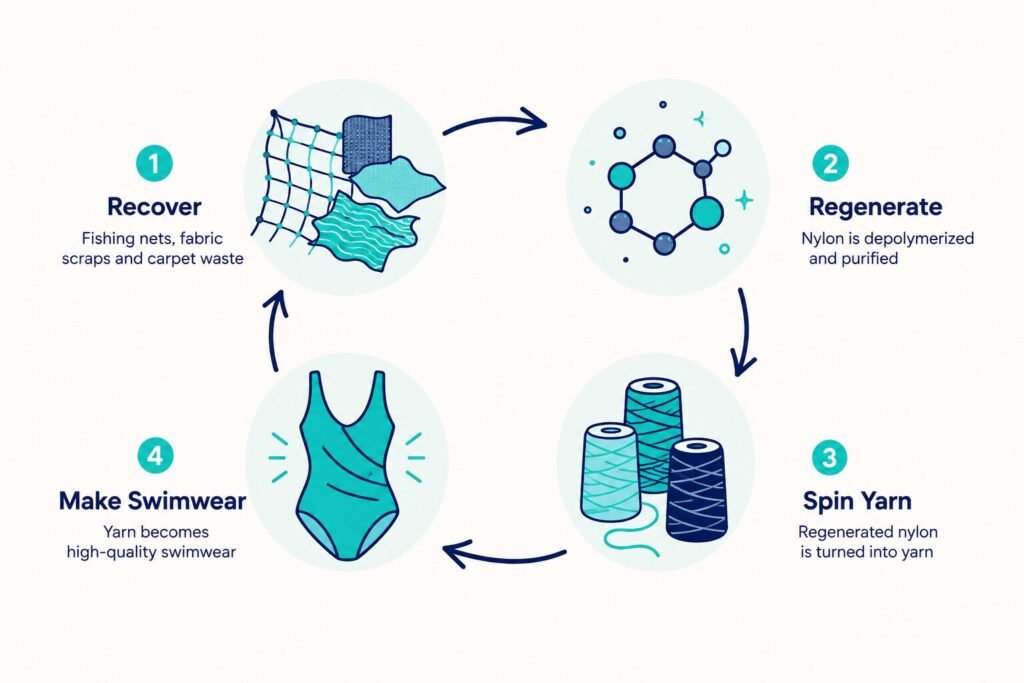
Developed by Italian textile manufacturer Aquafil, ECONYL® is a brand of regenerated nylon 6 made entirely from pre- and post-consumer waste. Unlike standard recycled polyester (rPET)—which is typically made from clear plastic beverage bottles—ECONYL is manufactured by taking nylon waste out of landfills and oceans, breaking it back down to its original chemical structure, and spinning it into pristine textile yarn.
How ECONYL Is Manufactured
- Rescue (Collection): Aquafil gathers nylon waste worldwide. Key raw inputs include discarded fishing nets (ghost nets), fabric scraps from clothing manufacturers, and carpet flooring destined for landfills.
- Regenerate (Depolymerization): The collected nylon waste undergoes a chemical depolymerization process. Unlike mechanical recycling (which melts plastic down and degrades fiber quality over time), chemical depolymerization breaks down the nylon polymer into its foundational monomer state (caprolactam).
- Remake (Repolymerization & Spinning): The recovered caprolactam monomer is purified and repolymerized into virgin-grade Nylon 6 resin. It is then spun into yarn for textile weaving.
- Reimagine (Fabric Construction): The yarn is knitted into elastic performance fabrics—most frequently blended with elastane (Spandex/Lycra) at ratios of 78% ECONYL to 22% elastane or 80/20 for optimal stretch and recovery in swimwear.
Because the chemical structure of regenerated nylon is identical to virgin petroleum-based Nylon 6, ECONYL fabric offers the exact same tensile strength, hand-feel, and performance profile as newly manufactured nylon.
ECONYL vs. Virgin Nylon vs. Recycled Polyester (rPET)
When developing a premium swimwear line, choice of fiber dictates garment durability, chlorine resistance, print clarity, and skin feel.
| Feature / Metric | ECONYL® (Regenerated Nylon 6) | Virgin Nylon 6 / 6,6 | Recycled Polyester (rPET) |
| Primary Raw Material | Ghost nets, fabric scraps, old carpets | Crude oil / Petrochemicals | Post-consumer PET bottles |
| Fiber Integrity | 100% equivalent to virgin nylon | Standard baseline | Slightly lower tensile strength than virgin poly |
| Hand-Feel & Comfort | Ultra-soft, smooth, luxury hand-feel | Soft, smooth | Stiffer, slightly rougher hand-feel |
| UV & Chlorine Resistance | High (when blended with Lycra Xtra Life) | High | High resistance to chlorine degradation |
| Dyeability & Color Depth | Excellent depth & vibrant prints | Excellent depth | Requires high-temperature sublimation |
| Environmental Impact | Reduces global warming impact by up to 90% vs. oil | High carbon footprint | Reduces plastic bottle waste; difficult to recycle again |
Technical Benefits for Swimwear Manufacturing
1. Shape Retention & Compression
Swimwear must withstand significant mechanical stress when wet while retaining its original recovery shape. When blended with high-grade elastane (such as Creora® Highclo or Lycra® Extra Life), ECONYL-based warp-knit tricot provides firm muscular compression and shape retention without sagging over prolonged use.
2. High Resistance to Chlorine, Sunscreen, and UV
Standard elastane and low-grade nylons break down rapidly when exposed to pool chlorine, body oils, and SPF lotion. Premium ECONYL fabric constructions utilize specialized finishing treatments that resist fiber degradation, yielding garments that hold up against harsh beach and pool environments.
3. Print Clarity and Dye Saturation
Nylon fibers accept dye at lower thermal thresholds than polyester, yielding vibrant solid hues and high-definition digital prints. Whether your line features deep solids or complex custom yardage prints, ECONYL delivers sharp graphic reproduction without color bleeding.
4. Verified Sustainability & Marketing Value
Sourcing verified materials allows brands to make transparent claims backed by third-party certification. Aquafil provides hangtags and certified supply chain tracking, helping you build consumer trust and protect your brand from greenwashing risks.
Key Sourcing Considerations for Swimwear Brands
If you plan to incorporate ECONYL into your upcoming apparel line, consider these manufacturing factors:
Supply Chain Certification: To use official ECONYL trademarks on garment hangtags and e-commerce listings, your garment factory must work through an audited supply chain. Ensure your OEM/ODM manufacturing partner holds a valid Global Recycled Standard (GRS) or OEKO-TEX® Standard 100 certification.
MoQ & Lead Times: Authentic ECONYL-certified fabrics from authorized mills (such as Carvico or Jersey Lomellina) carry higher minimum order quantities (MOQs) and slightly longer lead times than generic stock synthetic knits. Plan your sampling and tech pack production cycles accordingly.
Fabric Weight (GSM Selection):
- 170 – 190 GSM: Ideal for lightweight linings, double-layered bikini sets, and delicate fashion swimwear.
- 220 – 250 GSM: Standard weight for premium one-piece swimsuits, high-compression activewear, and men’s performance swim trunks.
Frequently Asked Questions (FAQ)
Is ECONYL fabric more expensive than virgin nylon?
Yes, ECONYL yarn typically incurs a 10% to 25% price premium over standard virgin nylon. This cost difference reflects the labor and chemical processes required to collect, clean, and chemically depolymerize ocean and landfill waste into virgin-grade resin.
How does ECONYL handle custom sublimation printing?
ECONYL fabrics take digital printing exceptionally well. However, because Nylon 6 has a lower heat tolerance than polyester, digital printing onto ECONYL requires precise temperature control (typically around 185°C to 195°C) to prevent elastane degradation or yellowing of white bases.
Is ECONYL fabric 100% recyclable?
Because the underlying nylon 6 polymer can be depolymerized repeatedly without loss of quality, pure ECONYL yarn is fully recyclable in a closed loop. However, once blended with elastane (Spandex) for swimwear elasticity, mechanical separation of the two fibers remains complex.
Conclusion
Navigating raw material sourcing, tech packs, and sustainable fabric certification can be challenging. Whether you are launching a new sustainable swimwear line or transitioning an established brand away from virgin synthetics, working with a specialized production partner ensures smooth manufacturing from design to delivery.
Looking to develop your next sustainable swimwear collection with certified ECONYL® fabrics?
Contact Us Today to request fabric swatch books, review factory MOQs, or get a custom quote on your tech pack.