
For any brand developing custom swimwear, a strong tech pack is one of the most important tools in the product development process. Whether you are working with a swimwear manufacturer for the first time or scaling an established line, a clear tech pack helps reduce mistakes, shorten sampling time, and improve communication across design, sourcing, and production.
Many brands assume a factory can work from a few reference images, a sketch, or a general idea of the fit they want. In reality, swimwear production is far more technical. Because swim garments involve stretch fabrics, lining choices, support structures, printing details, and precise fit requirements, incomplete information often leads to avoidable revisions, delays, and added cost.
A good swimwear tech pack does not need to be overly complicated. It simply needs to give the factory enough accurate information to understand what you want to make and how you want it made.
What Is a Swimwear Tech Pack?
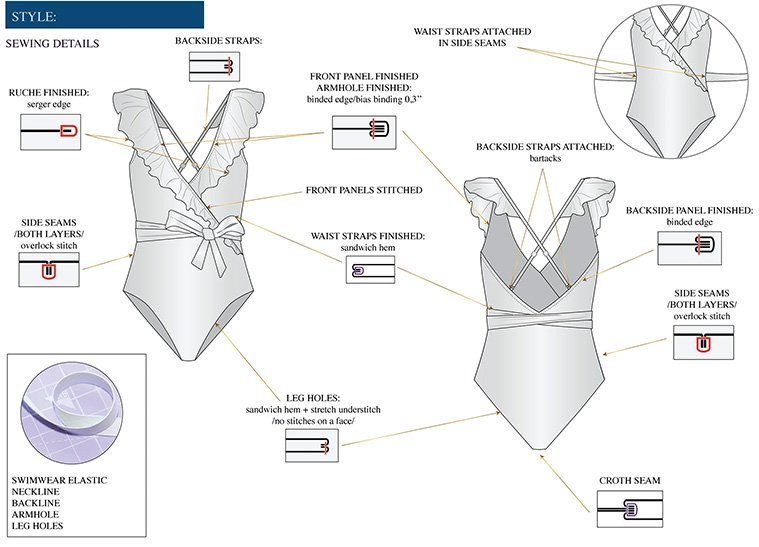
A swimwear tech pack is a product specification document used to communicate all key details of a design to the factory. It acts as the technical blueprint for development, sampling, and bulk production.。
For swimwear, this document usually includes design sketches, construction details, measurements, materials, trims, colorways, artwork placement, and packaging instructions. It also clarifies what is fixed and what is still open for discussion.
In B2B manufacturing, the tech pack is not just a design file. It is the main reference point that helps both the buyer and the manufacturer stay aligned throughout the project lifecycle.
Why Tech Packs Matter So Much in Swimwear Production
Swimwear is one of the more detail-sensitive apparel categories. Small changes in fabric recovery, strap length, elastic tension, cup shape, or seam position can significantly affect fit and performance.
That is why tech packs matter more than many new brands initially expect.
They reduce sampling errors
When the factory receives complete specifications, the first proto has a much better chance of matching your expectations. This reduces back-and-forth revisions and makes development more efficient.
They improve costing accuracy
A detailed tech pack allows the manufacturer to estimate fabric usage, trim requirements, construction complexity, and labor inputs more accurately. Without this, quotations are often only rough estimates.
They support consistent quality
During sampling and bulk production, the technical team refers back to the tech pack to confirm standards. This is especially important for private label swimwear, repeat orders, and multi-style collections.
They speed up communication
Clear documents reduce misunderstandings between designers, merchandisers, pattern makers, and production teams. This is particularly valuable when working across time zones and languages.
What a Swimwear Manufacturer Really Needs From You
Not every brand provides a fully professional tech pack, especially in the early stages. That is normal. A capable swimwear supplier can often help refine the file. However, there are still a few core elements the factory genuinely needs from the start.
1. Clear Design Overview
At minimum, the factory needs to understand what the garment is supposed to look like.
This usually includes:
Flat sketches or technical drawings
Front and back views are essential. Side views, close-up details, and internal construction notes are also helpful when relevant.
Reference photos
Inspiration images can support the sketch, but they should not replace technical information. A reference photo alone does not explain how the product should be patterned or constructed.
Style description
A short written summary helps avoid ambiguity. For example:
“Women’s triangle bikini top with adjustable neck and back ties, removable soft cups, fully lined, contrast binding, and gold metal logo trim.”
2. Fabric and Material Information
Material selection has a direct impact on appearance, fit, feel, durability, and cost. For custom swimwear, this section should be as specific as possible.
Main fabric
Include composition where available, such as nylon-spandex or polyester-spandex. If you already know the fabric weight or stretch direction requirements, note that as well.
Lining
Specify whether the garment is fully lined, partially lined, or requires power mesh in selected areas.
Padding and support components
If the style includes removable cups, underwire, elastic underbust support, or shaping features, this should be clearly stated
Trim details
Include rings, sliders, hooks, cords, logo plates, silicone tape, elastic types, and any special accessories.
If you do not yet know the exact fabric code, say so. A good swimwear manufacturer can propose suitable options, but the factory still needs to understand the target look, handfeel, performance level, and price positioning.
3. Measurement Specs and Size Range
Fit is one of the biggest challenges in swimwear production, so size information must be handled carefully.
Base size
Indicate which size the sample should be developed in, such as S, M, or a numerical size.
Point of measurement
List key measurements clearly. For swimwear, this may include bust width, underbust, waist, body length, cup height, side seam height, bottom rise, leg opening, and strap length.
Tolerance
If your brand has required tolerances, include them. This becomes especially important once you move into bulk production.
Grade rules
If you already have grading standards, add them. If not, some manufacturers can assist with grading based on your target market.
Many early-stage brands underestimate the value of precise measurement specs. Even an attractive design can fail commercially if the fit is inconsistent.
4. Construction Details
Construction notes are often what separate a usable tech pack from a purely visual design document.
Important details may include:
Seam types
For example, folded edge, clean finish, coverstitch, overlock, zigzag elastic application, or bonded finish.
Elastic application
Swimwear depends heavily on correct elastic placement and tension. Note where elastic is required and how it should be applied.
Cup or support structure
If the style includes molded cups, shelf support, underwire channels, or bust shaping seams, these details should be explicit.
Special finishing
Mention ruching, shirring, gathered channels, contrast piping, laser-cut edges, hardware attachment methods, or reinforced stress points.
In swimwear, construction is not a minor detail. It directly affects wearability, comfort, and product quality.
5. Print, Color, and Artwork Placement
If the style uses solid colors, contrast panels, all-over prints, engineered prints, or custom logos, the factory needs precise instructions.
Color references
Use Pantone codes when possible, or provide approved color swatches.
Print files
For custom print swimwear, send artwork in workable formats and identify scale, repeat type, and placement direction.
Placement guidance
If the print must align at the center front, side seam, or cup area, state this clearly. Placement is especially important in smaller garments like bikinis, where minor shifts can change the visual result significantly.
For wholesale swimwear or stock programs, this section may be simpler. For branded collections, it is usually essential.
6. Labeling and Packaging Requirements
Factories also need to know how the final product should be presented, not just how it should be sewn.
This may include:
- Main label type
- Care label content
- Size label placement
- Hangtags
- Barcode stickers
- Polybag requirements
- Set packing method
- Carton specifications
For private label swimwear, branding details should be included early, even if final artwork is still in progress.
7. Target Price and Order Context
A factory can technically make many versions of the same design, but the right construction solution depends on your commercial target.
Helpful context includes:
Target retail positioning
Are you developing for premium boutique retail, mid-market e-commerce, or promotional wholesale?
Target FOB range
A target cost helps the factory recommend materials and construction methods that match your pricing goals.
Expected MOQ or order volume
Development decisions may differ depending on whether you plan to order 100 pieces per style or a larger production run.
Launch timeline
Sharing your timeline helps the manufacturer manage sourcing, sampling, and production planning more realistically.
This commercial context is often missing from first-time inquiries, yet it is extremely useful for building a workable development plan.
What Happens When a Tech Pack Is Incomplete?
An incomplete tech pack does not automatically stop a project, but it usually creates friction somewhere in the process.
Common problems include:
Misaligned samples
The proto may look different from what the brand had in mind because too many assumptions were left to the factory.
Slower development
The team must pause repeatedly to confirm missing details, which lengthens lead times.
Quotation changes
Initial costing may need revision once materials, construction, or fit requirements become clearer.
Inconsistent bulk results
Without a strong reference document, quality control becomes harder during production.
In most cases, the cost of incomplete documentation is not just financial. It also affects launch timing and buyer confidence.
Does Your Tech Pack Need to Be Perfect?
No. It needs to be usable.
Many brands, especially startups, do not begin with a fully polished technical file. What matters most is whether the information is organized, accurate where it can be accurate, and honest about what still needs development support.
A reliable swimwear manufacturer will usually help bridge the gaps, especially in areas like fabric recommendation, pattern correction, fit adjustment, and construction refinement. The best working relationships are collaborative, but collaboration works best when the brand arrives with a solid foundation.
Best Practices Before Sending a Tech Pack
Before submitting your file, it helps to review a few practical points.
Keep design intent clear
Do not mix inspiration references with final decisions unless they are clearly labeled.
Separate confirmed details from optional details
This helps the factory know what is non-negotiable and what can be proposed or optimized.
Be realistic about development stage
If certain materials or measurements are not yet finalized, mention that directly.
Organize files properly
Name artwork, labels, color references, and style sheets clearly so the development team can work efficiently.
Ask for feedback early
An experienced factory can often spot technical or commercial issues before sampling begins.
Choosing a Right Manufacturer
Not all factories provide the same level of pre-production support. Some are mainly set up for order execution, while others actively support design translation, technical review, sampling, and process optimization.
For brands developing custom swimwear, this distinction matters. A factory that understands tech packs deeply can help identify issues in fit, construction feasibility, print application, or cost structure before those issues become expensive.
That is especially valuable for new collections, complex silhouettes, supportive swim styles, and brand-specific detailing.
Conclusion
A swimwear tech pack is not just paperwork. It is one of the most practical tools for turning a concept into a manufacturable product. In custom swimwear development, the better your documentation, the smoother your communication, the more accurate your sampling, and the stronger your final production outcome.
For brands working with a swimwear manufacturer, the goal is not to create the most complicated file possible. The goal is to provide the right technical and commercial information so the factory can develop the product correctly, efficiently, and consistently.
If your brand is preparing a new swimwear collection and needs support with tech packs, sampling, or production planning, contact us to discuss how we can help streamline your development and manufacturing process.
FAQ
A swimwear tech pack should include technical sketches, style descriptions, fabric details, trims, measurements, construction notes, color references, print placement, labeling instructions, and packaging requirements.
Yes. Many experienced manufacturers can help refine an incomplete tech pack, especially for fabric selection, fit correction, and construction details. However, the clearer your starting file is, the smoother the development process will be.
Reference photos can be useful, but they are not enough on their own. A factory needs technical details to interpret the design correctly and develop it for production.