
As we look toward the 2026 market cycle, the global swimwear industry is shifting away from the hyper-minimalism of previous years. Discerning consumers are now seeking “tactile luxury”—garments that offer visual depth, sophisticated silhouettes, and high-end finishing.
For brands, the challenge lies in integrating complex 2026 swimwear details like ruching, strategic cut-outs, intricate lace trim, and custom hardware without compromising on functional durability or production scalability.
In this guide, we analyze how these specific details are evolving for the 2026 season and what technical considerations must be addressed during the sampling and production phases.
Ruching Swimwear: soft appearance, technical function

Ruching continues to resonate because it combines fashion value with fit value. It creates movement, adds dimension to flat surfaces, and can make the body line feel more balanced without relying on heavy compression.
In trend coverage for 2026, sculpted and ruched silhouettes are still important part of the swimwear trend, creating a wavy effect at the torso or side seams through precise control of the fabric’s gather.
Enhancing Body Inclusivity
Ruching remains a powerful tool for brands prioritizing body inclusivity. By utilizing high-tension elastic thread and precision gathering, manufacturers can create suits that offer a “forgiving” fit while maintaining a high-fashion edge. This allows a single SKU to accommodate a wider range of body types comfortably.
Developing Ruched Swimwear
Ruching may look like a small visual detail, but in swimwear development, it affects both fit and construction. Different ruching placements create different results. Center-bust gathers usually give a softer and more feminine shape, while side-waist ruching or diagonal draping can make the silhouette look more sculpted.
Key Development Factors
When developing ruched swimwear, brands should pay attention to several technical points:
- Fabric tension: the gathered area should look natural rather than overly tight or loose
- Lining compatibility: a lining that is too rigid can cause uneven pulling on the outer fabric
- Ruching depth: too little gathering may disappear after wear, while too much can affect grading and fit balance
- Anchoring method: the gathers need to be fixed securely so both sides remain symmetrical in production
Why Pattern Planning Matters
For cleaner results, ruching should be built into the pattern from the start instead of being adjusted casually during sampling. Extra fabric allowance needs to be calculated clearly, and the gathering points should be placed consistently. This helps the sewing team maintain better symmetry and reduce variation in bulk production.
This is especially important for one-piece swimsuits, where torso length and fabric recovery directly influence how the ruched area sits on the body.
Cut-Outs Swimwear: Directional, But Less Forgiving
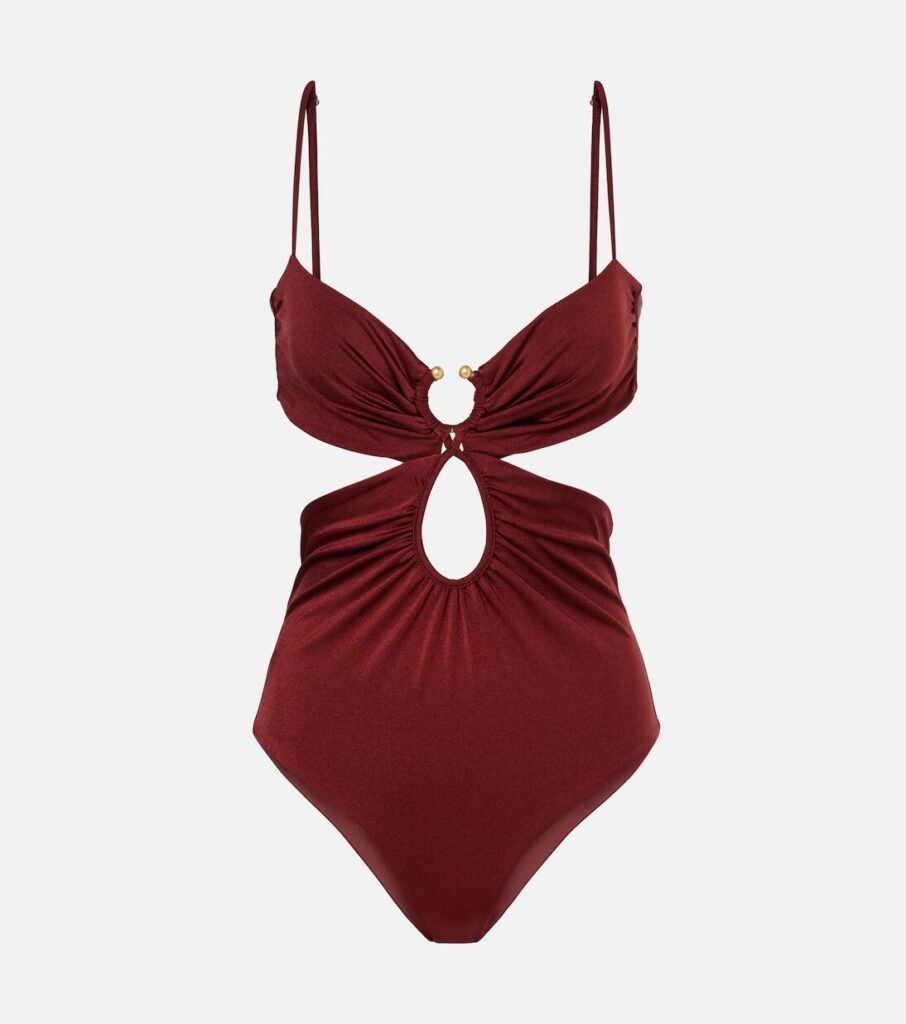
The 2026 silhouette is defined by “calculated exposure.” Cut-outs are no longer haphazard; they are strategically placed to follow the natural lines of the body, often reinforced with internal binding to prevent rolling or gapping.
What Makes Cut-Outs More Technical
In production, cut-outs are less forgiving than they appear. Once fabric is removed, support has to be redistributed elsewhere. That can affect:
- neckline stability
- bust support
- strap tension
- seam reinforcement
- how the style behaves when wet
A cut-out that looks balanced in one sample size may not hold the same proportion across a full size range. This is why brands should not judge this detail from one fit sample alone. Testing multiple sizes is usually necessary.
Best Practice in Sampling
For cut-out styles, it helps to confirm both visual line and functional hold before final approval. Hidden elastic support, clean finishing, and stable seam paths often make the difference between a style that looks elevated and one that feels under-engineered.
Lace Trim: A Softer, More Romantic Direction
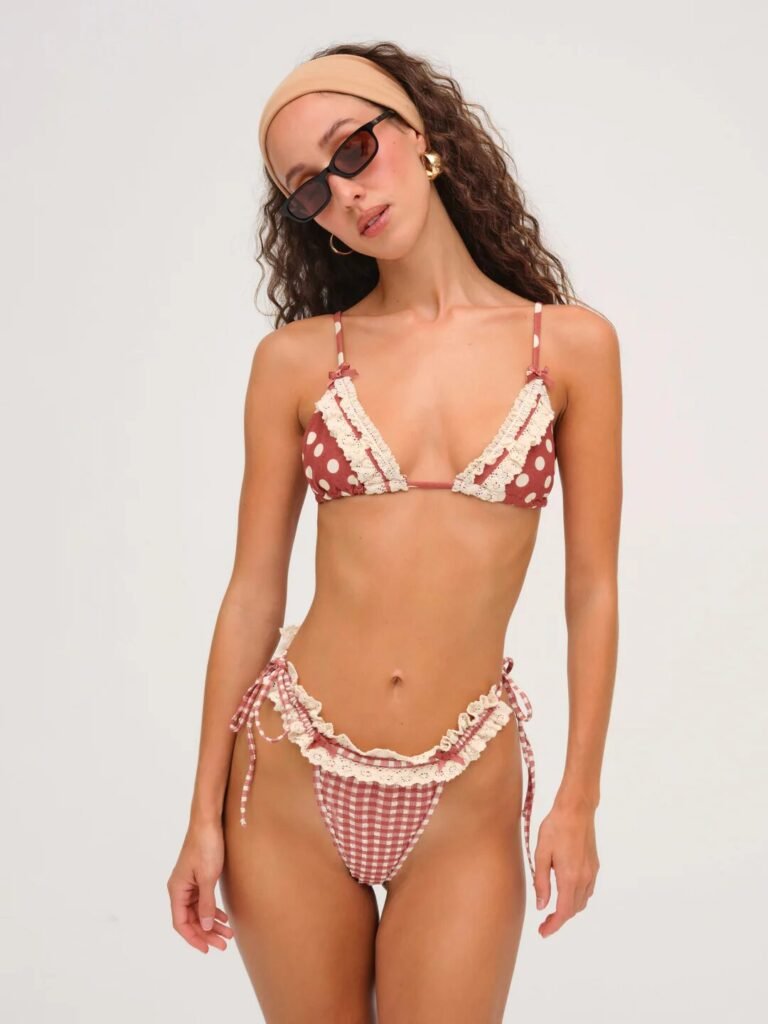
The “coquette” and vintage-revival aesthetics continue to influence 2026 trends. Lace trims, scalloped edges, and crochet-style borders are being integrated into fashion swimwear to bridge the gap between beachwear and “resort-to-street” apparel.
Where Lace Trim Fits Best
Lace trim usually works best when the overall silhouette is already clean. On a simple triangle top, bandeau, or fitted one-piece, a controlled lace edge can add enough distinction without overwhelming the garment.
The most commercially useful applications are often:
- neckline trim
- cup-edge detailing
- soft layered accents
- selective contrast inserts for resort-oriented styles
Technical Considerations
This detail needs careful material selection. Not all lace is suitable for swimwear. The trim should be evaluated for stretch, recovery, colorfastness, and compatibility with chlorinated or salt water environments.
Even when lace is used only as a decorative element, it still has to work with the behavior of the main swim fabric. If the trim absorbs too much water, curls at the edge, or loses resilience, the final garment will quickly feel less premium.
For many brands, lace trim is best treated as a detail for selective pieces rather than a full-line direction.
Beads, Hardware, and Jewelry-Inspired Accents

The use of beads and metal hardware can serve as the finishing touch in swimwear design. Vogue’s recent 2026 swimwear trend report highlighted embellished bikinis, further confirming that decorative elements are becoming an increasingly important part of swimwear product identity.
Why They Work So Well
These details can elevate even a minimal design. A simple ring connection, metal slider, charm-like accent, or small bead detail can make a basic silhouette feel more premium and more styled.
They are especially effective for:
- premium resort collections
- statement bikini capsules
- fashion-forward
- styles designed for strong visual merchandising
What Needs to Be Checked
This category looks simple from a design perspective but requires discipline in manufacturing. Hardware and embellishments should always be reviewed for:
- corrosion resistance
- edge smoothness
- attachment security
- comfort against the skin
- performance under repeated stretch
Placement matters as much as material choice. Heavy trims on high-stretch zones can distort the garment or reduce wear comfort. In most cases, one well-placed trim element creates a stronger result than too many competing decorative parts.
How to Combine These Details Without Overdesigning
One of the biggest risks in trend-led development is trying to use every new idea at once. A swimsuit does not need ruching, cut-outs, lace trim, and beads all together to feel current. In fact, too many details often weaken the product.
A stronger approach is to build each style around one lead detail and one supporting detail. For example:
Good Combinations
- ruched one-piece with Minimalist Design
- cut-out swimsuit with hardware
- triangle bikini with delicate lace edge
- simple bandeau with subtle bead accent
This kind of balance makes the product easier to fit, easier to cost, and easier to merchandise.
What Brands Should Prioritize Before Bulk Production
Before moving into full production, detail-led swimwear should always go through a more careful review than basic essentials.
Recommended Checks
- Confirm the detail looks balanced across more than one size
- Test trim behavior with the actual swim fabric and lining
- Review stretch recovery after repeated wear simulation
- Check whether the detail affects sewing efficiency or consistency
- Make sure the final look matches the target price level
These steps help reduce common problems later, especially on styles that rely heavily on appearance.
Conclusions
For 2026 swimwear, details are not just styling accents. They are product-defining decisions. Ruching, cut-outs, lace trim, beads, and hardware can all help a collection feel more relevant, but only when they are developed with the right balance of design intent, wearability, and production control.
At Joy Sportwear, we leverage our extensive experience in swimwear manufacturing to help brands transform their detail-oriented swimwear concepts into mass-producible products. Contact us today!