As family beach trips, water parks, and school swim programs become more common, kids’ swimwear is being worn more often than ever. Parents now look for comfort, quick-dry performance, and chlorine-resistant durability, while kids gravitate toward bright colors and playful details.
Many brands want to enter this growing category, but kids’ swimwear demands tighter standards than everyday apparel—from fabric performance and fit to construction and safety checks. This guide breaks down the full manufacturing process, from material selection to final quality inspection.
1.Kids Swimwear Material
In kids’ swimwear, fabric is the foundation of brand loyalty. If a suit sags after three swims or causes a rash, the customer won’t return.
Most swimwear is a blend of synthetic fibers and elastomers.
- Polyester (PBT): This is the gold standard for durability. PBT (Polybutylene Terephthalate) is naturally chlorine-resistant and holds its shape significantly better than nylon. It is ideal for competitive youth swimwear or frequent pool users.
- Nylon (Polyamide): Known for its “hand-feel,” nylon is softer and more lustrous. It’s the go-to for fashion-forward boutique lines. However, it is more susceptible to “pilling” when a child sits on the rough edge of a concrete pool.
- The Spandex Factor: High-quality kids’ suits typically use Xtra Life Lycra™. Standard spandex degrades quickly in heat and chlorine; Xtra Life is engineered to last 5–10 times longer.
Weight and “Hand-Feel”
For kids, the GSM (Grams per Square Meter) matters. You want a weight between 190gsm and 220gsm. Anything lighter will become transparent when wet (a major safety and quality fail); anything heavier becomes a “water log” that weighs the child down and takes hours to dry.
2. Compliance and Regulation
Manufacturing for children is a legal minefield. Ignorance is not a defense when it comes to international safety standards.
UV Protection: The UPF 50+ Standard
A standard cotton T-shirt provides a UPF of about 5. Most kids’ swimwear brands aim for UPF 50+, which blocks 98% of UVA and UVB radiation. This is achieved through a tight weave or chemical finishes. As a manufacturer, you must verify that the UPF rating remains effective even after 50+ washes.
Chemical Safety
Ensure fabrics are OEKO-TEX® Standard 100 certified, meaning they are free from harmful substances like lead, phthalates, and PFAS.
Mechanical Safety (The “Choke and Trip” Check)
- Drawstrings: In the US and EU, drawstrings at the neck or waist of kids’ clothing are heavily regulated to prevent entanglement.
- Appliqués: Any buttons, bows, or sequins must undergo a pull-test (typically 90 Newtons for 10 seconds) to ensure they won’t pop off and become a choking hazard.
3. Grading and Ergonomics
Adults mostly stand or lounge in swimwear. Kids climb, squat, sprint, and tumble.
The “Nappy” Variable
For the 0–3 age group, the design must accommodate swim diapers (nappies). This requires a wider “crotch gusset” and more elastic recovery in the leg openings to prevent leaks.
Growth Spurt Grading
“Grading” is the process of turning a Sample Size (usually a 4T or 6) into a full range. Kids’ bodies change proportions as they grow—toddlers have prominent bellies, while tweens lean out. A linear scale doesn’t work. You need a pattern maker who specializes in pediatric anthropometrics to ensure a size 2 fits as well as a size 12.
4. The Production Pipeline: From Tech Pack to Shipping

Step 1: The Tech Pack
our Tech Pack is your blueprint. It should include:
- Detailed CAD sketches.
- A Bill of Materials (BOM).
- Grading scales (e.g., sizes 2T through 12).
- Stitch specifications (Flatlock stitching is preferred for swimwear to prevent chafing).
Phase 2: Sourcing & Prototyping
Once the tech pack is ready, the factory creates a “Fit Sample.”
- Action: Test this sample on a real child, not just a mannequin. Kids move differently—they squat, jump, and climb. The suit needs to stay put.
Phase 3: Bulk Production
After the “Gold Seal” sample is approved, bulk production begins. This includes:
Sublimation Printing
Unlike “screen printing,” which sits on top of the fabric and can crack, dye-sublimation bonds the ink to the fibers. This is essential for the high-stretch environment of a swimsuit, ensuring the print doesn’t “white out” when stretched.
Cutting & Sewing: Specialized machines are used to handle the slippery, high-stretch nature of the fabric.
Step 3: Quality Control
Before the goods leave the factory, a final inspection should be conducted to check for:
- Symmetry: Are the leg holes even?
- Colorfastness: Does the dye bleed when wet?
- Seam Strength: Do the seams pop when the fabric is stretched to its limit?
5. Finding a Manufacturing Partner
The “Made in…” label matters more than ever. Modern parents are “conscious consumers.”
Factory Vetting
When choosing a factory in hubs like China, Vietnam, or Bali, look for these certifications:
- BSCI / Sedex: These ensure fair wages and safe working conditions.
- GRS (Global Recycled Standard): If you are claiming to use recycled ocean plastic (like Econyl), your factory must be GRS certified to prove the chain of custody.
The MOQ (Minimum Order Quantity) Hurdle
Swimwear factories often have high MOQs because the specialized machines take time to calibrate. Expect MOQs of 100 – 300 pieces per style. For startups, look for “small-batch” manufacturers who may charge more per unit but reduce your inventory risk.
6. Emerging Trends in Kids’ Swimwear
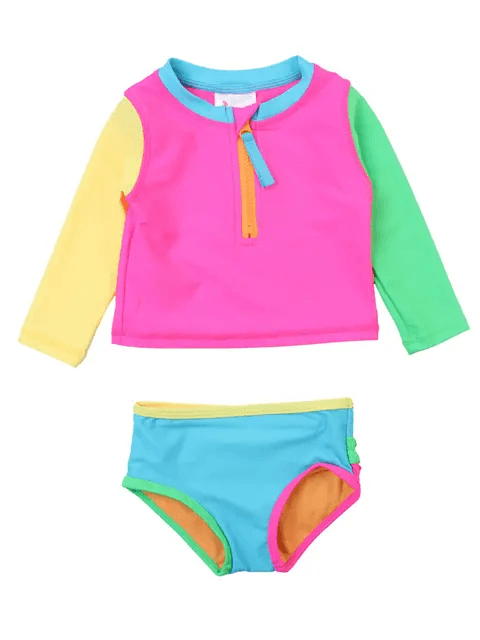
To stay competitive, your product should reflect these shifts—because kids’ swim is no longer “mini adult swim.” Parents buy for safety + function:
Pick Bright Colors for Safety:
“Cute” still matters, but visible is becoming a real purchase driver. A 2025 pool visibility test (3 ft depth) found neon orange, neon green, bright yellow, and hot pink were the easiest to spot, while large dark prints lowered visibility.
UPF / Sun Protection Is Driving Higher-Coverage Styles
Parents aren’t buying kids’ swimwear for style alone anymore—they’re buying sun protection they can trust. The sun-protective clothing market is projected to reach $16.53B by 2032 , up from around $9.48B in 2025.
That growth is showing up clearly in kids’ swim: more demand for rash guards, long-sleeve sets, and zip-front suits that keep children covered during long hours outdoors.
Sustainable Fabrics at Scale
Sustainability is shifting from “nice-to-have” to “expected,” especially in kidswear. Recycled polyester and eco fabric stories can still win—but only if the product feels premium and lasts.
Brands can combine eco-friendly messaging with durability: “Can be used for multiple seasons” is more persuasive than simply “recyclable.”
Conclusion
In the world children’s swimwear , quality is the best marketing strategy. By focusing on high-performance PBT fabrics, strict safety compliance, and ergonomic sizing, you create a product that solves parents’ biggest challenge: keeping children safe and comfortable in the water.
If you are developing a Kids swimwear collection, Joy Sportwear, as an ethical swimwear manufacturer , would be delighted to assist you.